- query@titaniumagency.net.pk
- +92 310 0001036
- +92 334 4139539

Introduction: Islamabad’s Tallest Skyscraper Is Set to Transform the Capital
Islamabad’s Tallest Skyscraper is no longer just a concept—it is becoming a defining reality for Pakistan’s capital city. In a groundbreaking move that signals a shift toward vertical urban development, Faisal Town has announced a landmark partnership with globally renowned architectural firm Aedas.
Planned for the prestigious New Blue Area, this mega project aims to reshape Islamabad’s skyline and redefine the country’s approach to high-rise construction. More than just an engineering feat, the tower represents modernization, sustainability, economic growth, and Pakistan’s arrival on the global architectural stage.
This blog explores every dimension of this historic collaboration—from location strategy and architectural vision to sustainability, smart technology, economic impact, and the future of Pakistan’s urban development.
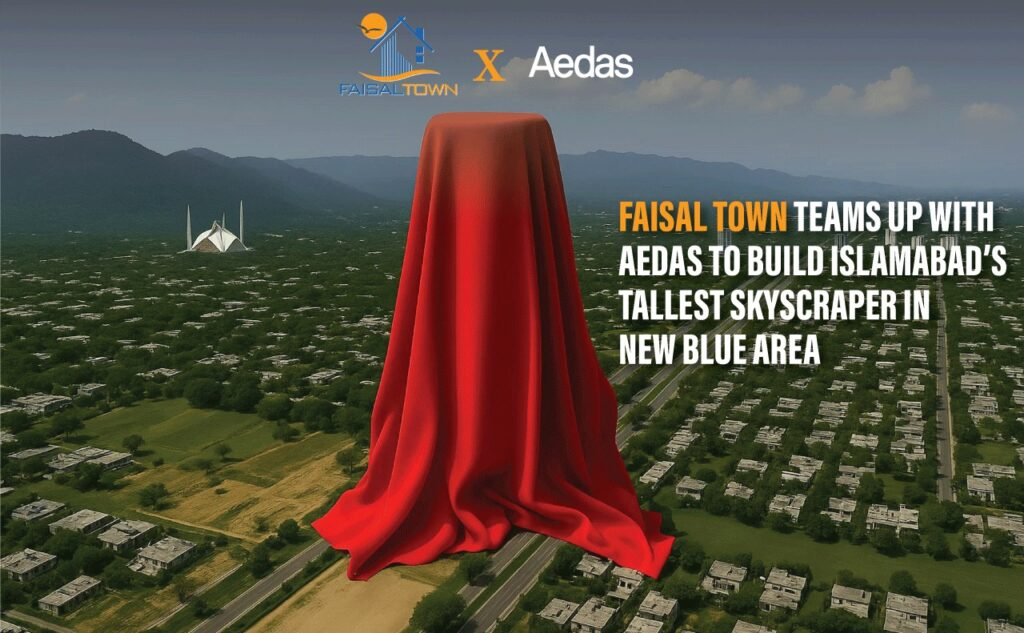
A Historic Collaboration: Faisal Town & Aedas Unite
Vision Beyond Boundaries
The partnership between Faisal Town and Aedas was officially announced during a formal ceremony held at Aedas’ Singapore office. Leaders from both organizations shared a unified vision: to create a structure that symbolizes Pakistan’s architectural progress while meeting global standards of sustainability and design excellence.
Faisal Town, already known for delivering large-scale residential and commercial projects, is stepping into vertical urban development for the first time. Aedas, with decades of global experience, brings international design intelligence and innovation to the table.
This collaboration merges:
- Local market expertise
- Global architectural innovation
- Sustainable urban planning
- Technological integration
Together, they are setting the foundation for Islamabad’s tallest skyscraper—an iconic symbol of forward-thinking development.
Why Islamabad Needs Vertical Development
Moving Beyond Horizontal Sprawl
Pakistan’s real estate development has traditionally favored horizontal expansion—housing societies spreading outward across acres of land. While effective in the past, this model has limitations:
- Land scarcity in prime urban areas
- Increased infrastructure costs
- Environmental strain
- Traffic congestion
Islamabad’s skyline has remained relatively low-rise compared to other global capitals. With rising commercial demand and increasing population density, vertical growth is the logical next step.
This skyscraper signals a decisive shift toward:
- Efficient land use
- Mixed-use development
- High-density commercial hubs
- Sustainable city planning
The Strategic Importance of New Blue Area
Prime Location Advantage
The project’s location in New Blue Area is no coincidence. This newly planned commercial district is rapidly emerging as Islamabad’s future business epicenter.
Nearby Key Intersections & Infrastructure:
- F-8 Interchange
- F-10 Intersection
- Serena Hotel Interchange
These connections ensure seamless accessibility from major sectors and highways.
By choosing New Blue Area, Faisal Town aligns with the government’s vision of transforming the district into a modern financial and commercial hub.
This skyscraper will not simply occupy prime land—it will elevate its value and catalyze further commercial expansion.
Meet Aedas: The Global Design Powerhouse
A Reputation Built on Innovation
Aedas is internationally recognized for designing some of the world’s most iconic structures across Asia, Europe, and the Middle East.
Notable global projects include:
- Parqal in Manila
- The Star Performing Arts Centre in Singapore
Their architectural philosophy blends:
- Cultural sensitivity
- Modern innovation
- Sustainability
- Functional excellence
With Aedas leading the design of Islamabad’s tallest skyscraper, Pakistan enters the global architectural conversation with authority.
Architectural Philosophy: Sustainability Meets Luxury
Designing for the Future
Unlike traditional high-rises that prioritize height over efficiency, this project will integrate:
- Passive solar design
- Energy-efficient facades
- Smart ventilation systems
- Rooftop gardens
- Shaded terraces
Islamabad, known for its green belts and the Margalla Hills, demands environmental sensitivity.
The tower will harmonize with its natural surroundings rather than overpower them.
Mixed-Use Excellence: Residential + Commercial Integration
Islamabad’s Tallest Skyscraper will not be limited to one purpose. It will function as a fully integrated urban ecosystem.
Planned Features:
- Premium residential apartments
- Grade-A commercial offices
- Retail spaces
- Hospitality integration
- Rooftop cafes
- Wellness hubs
- Public courtyards
This combination ensures:
- Continuous activity
- Diverse tenant base
- High commercial footfall
- Vibrant community life
Faisal Town’s Track Record of Success
Faisal Town has delivered:
- Over 130,000 residential units
- 60,000+ commercial units
- 8 major developments
Notable projects include:
- Faisal Margalla City
- Faisal Hills
This skyscraper represents Faisal Town’s vertical expansion strategy—its most ambitious endeavor to date.
Economic Impact: A Catalyst for Growth
Job Creation
The project is expected to generate employment in:
- Construction
- Engineering
- Architecture
- Interior design
- Facility management
- Technology
Foreign Direct Investment (FDI)
An internationally designed landmark structure will attract:
- Overseas Pakistani investors
- Global corporate tenants
- Hospitality brands
- International retail chains
Market Standardization
By setting new architectural benchmarks, the project could inspire similar developments in:
- Karachi
- Lahore
Smart Technology Integration
Modern skyscrapers must function as intelligent ecosystems.
Expected Smart Features:
- AI-powered energy management
- IoT-enabled security systems
- Predictive maintenance systems
- High-speed fiber internet
- Digital access control
- Remote monitoring
The tower aims to become a digital fortress, future-ready for smart city integration.
Engineering Excellence & Safety
Islamabad lies in a seismically active region. Therefore, structural safety is paramount.
Planned Engineering Standards:
- Earthquake-resistant design
- Fire suppression systems
- Green building certification
- High-grade construction materials
- International safety compliance
With Aedas’ global expertise, the tower will align with world-class engineering practices.
Community-Centric Development
Despite its grandeur, the tower will remain accessible and inclusive.
Community Features:
- Open retail spaces
- Art venues
- Public gathering courtyards
- Lifestyle facilities
- Food courts
- Recreational areas
This transforms the skyscraper into a destination—not merely a workplace.
Transforming Islamabad’s Skyline
Globally, city skylines represent economic strength and ambition.
- New York has One World Trade Center
- Dubai has Burj Khalifa
- Shanghai has Shanghai Tower
Islamabad’s Tallest Skyscraper will symbolize:
- Pakistan’s modernization
- Global competitiveness
- Architectural confidence
It will become a landmark visible across the capital.
Environmental Responsibility
Sustainability is central to the project.
Key Green Strategies:
- Reduced carbon footprint
- Local sourcing of materials
- Efficient insulation
- Solar optimization
- Smart water management
This ensures harmony between urban growth and environmental preservation.
Approval Process & Development Timeline
While no official completion date has been announced, early groundwork has begun.
Development Approach:
- Transparent approval processes
- Coordination with local authorities
- Phased construction planning
- Community engagement
The strategy emphasizes precision over speed.
Impact on Pakistan’s Real Estate Industry
This project signals:
- A shift toward vertical urbanization
- Increased global partnerships
- Higher architectural standards
- Smart city development models
If successful, it may redefine how future Pakistani cities are planned.
The Future of Smart Cities in Pakistan
Islamabad’s Tallest Skyscraper could serve as:
- A model for future high-rises
- A blueprint for sustainable vertical growth
- A benchmark for smart infrastructure
Cities evolving toward verticality can better manage:
- Population density
- Infrastructure strain
- Environmental sustainability
A National Symbol of Ambition
This skyscraper transcends real estate—it represents:
- Vision
- Progress
- Innovation
- National confidence
It positions Pakistan alongside nations leading global urban transformation.
Investment Perspective
For investors, this project offers:
- Prime commercial location
- International design credibility
- Long-term capital appreciation
- Rental yield potential
- High brand value
Early-stage developments often offer maximum growth potential.
Final Thoughts: A New Era Begins
Islamabad’s Tallest Skyscraper is more than steel and glass—it is a declaration of Pakistan’s readiness to embrace the future.
The collaboration between Faisal Town and Aedas marks a turning point in the nation’s urban journey. As construction progresses and designs materialize, Islamabad prepares to witness not just its tallest building—but its boldest statement of ambition.
In the coming years, when this tower rises above the skyline, it will stand as:
- An engineering marvel
- An architectural icon
- A commercial powerhouse
- A national symbol
Pakistan is ready to rise—both literally and metaphorically And Islamabad’s Tallest Skyscraper will lead the way.